Watercolor; Expressive Bodies in Rope: Watercolor & Shibari Life Drawing Workshop with Alireza
In December 2025, Shibari Studio Berlin opens its doors for a very special collaboration: an expressive watercolor life drawing workshop framed by an intimate Shibari performance. Together with Berlin-based artist Alireza aka Aryo Kunstwelt, we invite participants to explore how rope, bodies, light, and pigment can translate tension, trust, and movement onto paper.
In this conversation, Alireza shares how he approaches live drawing in such charged settings, what guests can expect from the workshop, and why Shibari is such a powerful source of visual inspiration.
For people who don’t know you yet: how would you introduce yourself and your work in a few sentences?
I love the human body and its countless forms, and I enjoy portraying them. My works usually grow out of direct interaction — a kind of symbiosis with what’s happening around me. It’s always a collaboration. So you’ll rarely find me in a fantasy world.
How did you first get into life drawing and watercolor – and what made you stick with it?
I’ve been drawing for as long as I can remember. Even when I stopped painting for years, I never stopped sketching. During the lockdown in 2020 I picked up my pens and brushes again, joined online life-drawing sessions, and rediscovered color through soft pastels and urban sketching with watercolors.
Watercolor came back to me through fast, dynamic performance sessions — too quick for pastels, but perfect for loose, expressive washes. Once I started using professional materials, something clicked, and watercolor suddenly felt alive, intuitive, and full of possibilities. Since then, it has become my main medium for life drawing and live performance work.
How did the idea for this specific “Expressive Shibari Life Drawing with Watercolors” workshop at Shibari Studio Berlin come up?
I love Shibari, and I got to know it better through kinky life-drawing sessions at IKSK Berlin. Shibari offers fantastic opportunities for figurative drawing: poses you rarely see in daily life, and an intimacy that pulls you in.
My approach to life drawing is always expressive — with charcoal, pastels, or watercolor. It’s the best way to convey atmosphere, emotion, and movement. People often tell me they want to get into life drawing but feel intimidated by anatomy, color, or simply the pressure to “do it right.”. Besides I also frequently get asked or praised: “wow, how you do that?!” So I thought I get the question literally since I believe it’s not a magic.
I had already been in touch with studios about running guided courses when Dorcara and you invited me to their life-drawing sessions. I loved your space and the energy of the session. So I asked if we could co-organize workshops as well.
In this workshop, I want to share my process and offer people an enjoyable, relaxed creative experience. Let’s just have fun together, learning and exploring.
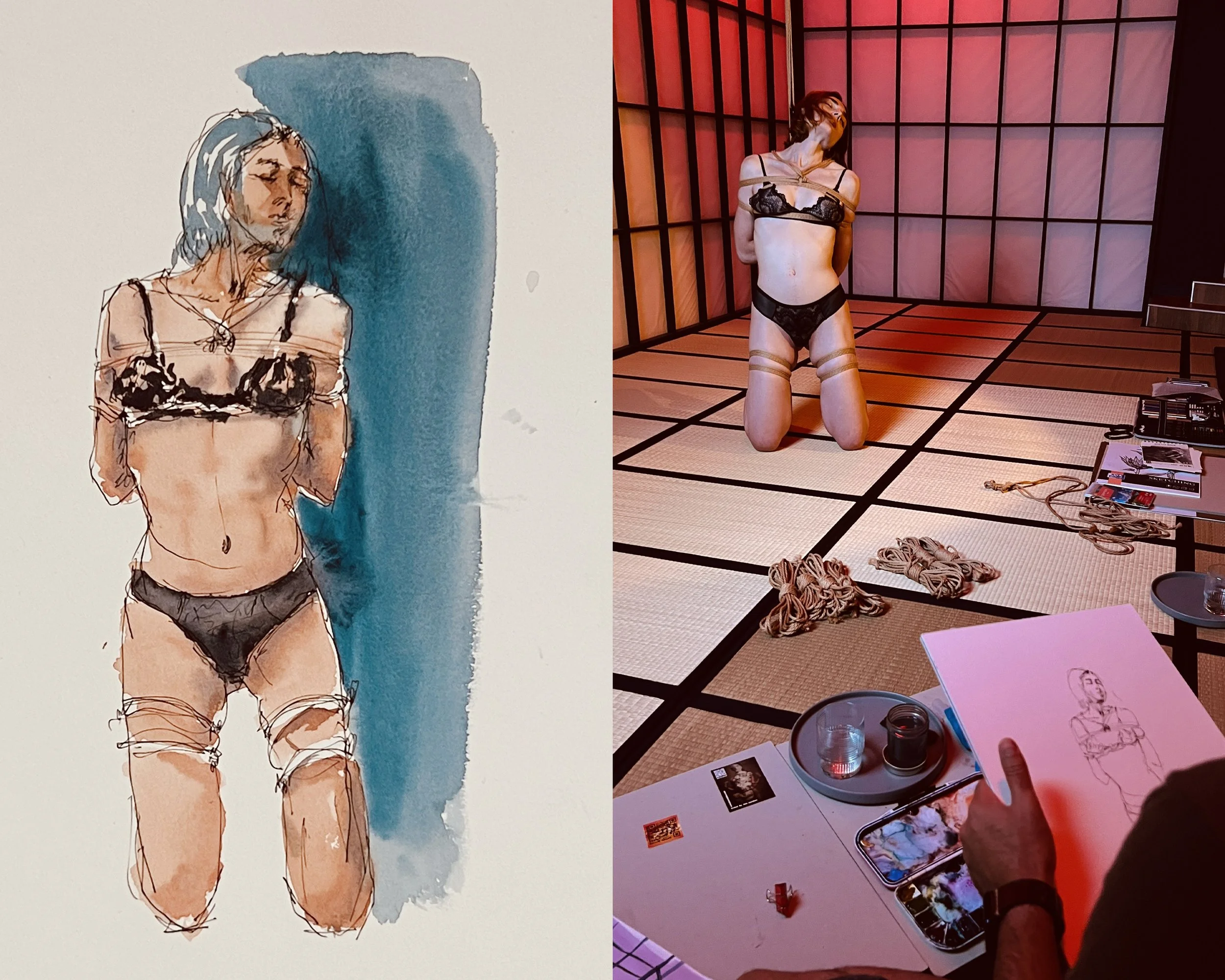
Alireza (on the right) drawing Dorcara in a life drawing session.
In your own words: What makes this workshop different from a classic life drawing class?
Most classical life-drawing classes focus heavily on academic methods, anatomy theory, and static poses. Nothing wrong with that — but I think people should also have fun while learning.
This workshop keeps some classical elements but is more playful, color-friendly, and focused on observation and immediacy. Watercolors in life drawing are still quite uncommon — and they bring a very different energy.
When you paint in this setting, what actually guides what you put on the paper – the rope, the bodies, the atmosphere in the room?
This is a very interesting question and a hard one to answer. It varies constantly, and can be any combination of these elements, like the body poses, the esthetic rope knots, the emotional gases and sensual touching between the rigger and the model. Or even isolated body parts hugged in ropes.
The workshop focuses on movement, emotion, and fast, free lines rather than perfect anatomy. What are you inviting people to explore instead?
To explore their raw creativity.
Basically: turn off the part of your brain that overthinks, and let your hand follow your gaze. I hope people can reconnect with the child inside them — the one that draws without fear.
The idea is to learn key skills for drawing from life and how to be fast. But ultimately to experience what I experience: transferring how one feels from the performance onto the paper.
Can you walk us through the flow of the evening – from arrival to the last drawing round? What can people expect step by step?
When people arrive, we start with a small introduction round and a short talk about Shibari.
Then I explain the materials and what we’ll do with them. While you and Dorcara prepare, we do some warm up studies from them with pencil and fountain-pen. It’s all about drawing what you actually see, not what you think you see. I explain techniques like blind contour drawing, one-lining, and explain tonal values.
Then we switch to watercolor — color mixing, quick washes, and looseness.
The first rope session starts with a 15-minute demo where participants look over my shoulder. After that, they get to sketch one or two poses for about 30 minutes. I walk around, answer questions, and give active feedback.
We take a break — tea, talking, decompressing — then repeat the process with a second rope session.
At the end, we gather all the works, look at them together, share feedback, and close the evening with some final thoughts.
You’ll be doing live demos from sketch to finished watercolor. What do you want people to see or understand when they watch your full process?
I want them to see fundamental drawing techniques in action — blind contour, exaggeration, building forms with geometric surfaces. Also how watercolor actually works: mixing, washes, tonal values, building depth fast.
If you’re too slow, you miss the moment — and with it the energy. It’s about not getting caught in not important details. I believe that the faster you become, the more expressive you can be.
The event description mentions that all high-quality materials are included. Why is it important to you to work with good paper, pigments, brushes and tools, especially for expressive work?
With watercolors, professional materials make an enormous difference — even for beginners. All three components matter: pigment, paper, and brushes.
High-pigmented colors let you mix vibrant tones that bring life to the page. And energize you while sketching or painting.
The colors flow beautifully on 100% cotton paper — it lets you use enough water without destroying the surface. The right paper keeps the colors vibrancy after application.
A good all-round brush helps you create smooth washes and switch to details when you need to. Many watercolor effects simply don’t happen with student-grade materials. It feels like having a cheat sheet: it makes your life easier and your experience more enjoyable.
We were only able to keep the ticket price accessible because these materials are kindly sponsored. We use Daniel Smith Extra Fine Watercolors, Baohong 100% cotton 300gsm paper, and Renesans watercolor brushes.
Is this workshop more for beginners, for experienced artists, or truly for both? What does each group usually struggle with – and how do you support them?
For both.
Beginners often struggle with observation skills — seeing what’s actually in front of them — or they overthink. Others feel insecure about colors.
Some skilled illustrators can’t overcome their perfectionism.
More advanced people sometimes benefit from stepping out of their usual process, trying a different approach, or getting constructive feedback. A good critique helps everyone grow.
The workshop is quite intimate and small-group. What kind of atmosphere do you personally want to create in the room?
I love the cozy, aesthetic setup of the space at Shibari Studio Berlin. Everything contributes — the Japanese inspired wall and floor decoration, the gear, the lighting, the music. It puts you in the right mood instantly. The space welcomes you and makes you feel safe.
A small group also helps: it keeps the evening intimate and makes it easier for me to give personal attention to everyone.
If participants take only one thing away from this evening – for their art or for their life – what do you hope it will be?
To have fun — and to connect more deeply with their surroundings.
To really see the people and the environment around them.
Thank you Alireza for your time and effort bringing this workshop to live – can’t wait to see you drawing again!
Thank you too, happy to collaborate.
More from Alireza on Instagram, connect and/or ask direct questions: here!
All details about our upcoming workshops and tickets:
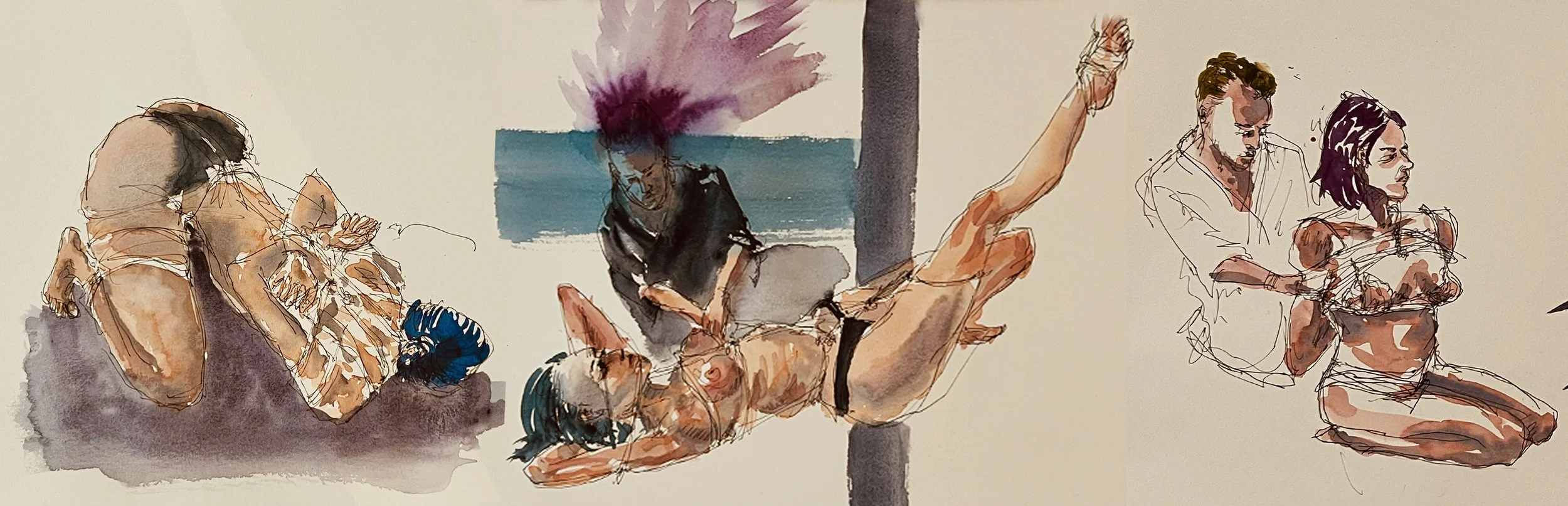
Drawings from Alireza / Dorcara tied by Dan Carabas in a life drawing evening.